
How to Rank in Google AI Overviews: What Website Owners Need to Know
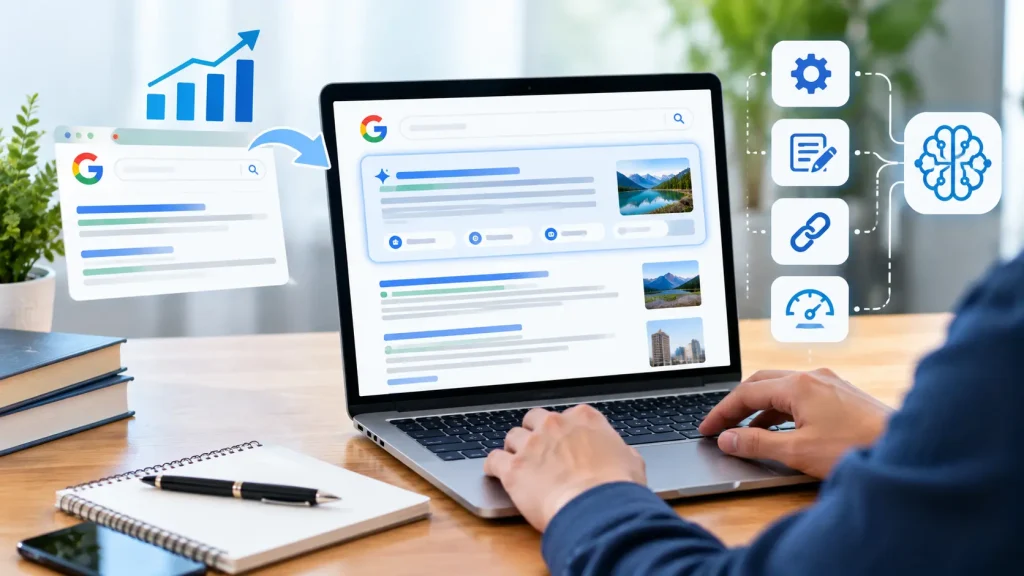
Google AI Overviews have changed how people find information through search. Instead of relying only on a list of website links, users can now see an AI generated summary with links to sources that support the answer. For Australian businesses, this creates another way to reach customers, but it also raises a practical question: how can your website earn a place in these results?
If you want to know how to rank in Google AI Overviews, start with the foundations of good SEO. Google needs to access your pages, understand their content and consider them useful for the question being asked. Your website also needs to meet Google’s requirements for inclusion in its AI search features. Even when these conditions are met, Google does not guarantee that a page will appear in an AI Overview.
The best approach is to improve the pages that matter to your business, support your claims with useful evidence, build clear links between related topics and measure the results. This guide explains how to do that without relying on tricks that promise quick placement.
What are Google AI Overviews and Why Do They Matter?
Google AI Overviews are AI generated summaries that appear within Google Search for selected queries. They bring together information from sources that Google considers relevant to the question and provide links that users can follow to learn more. The format can help people get an initial answer, but it can also change how much attention they give to the traditional search listings below.
For businesses that rely on organic traffic, the key issue is visibility. A page may rank well in the normal search results but still miss an opportunity to appear as a cited source in an AI Overview. A page that earns a citation may reach someone who needs more detail than the summary provides. This makes useful content and sound technical SEO important for both traditional search and Google’s AI features.
Google’s official guide to generative AI features in Search confirms that existing SEO practices remain relevant. Its systems use Google’s Search index and ranking systems to find relevant information, then present links that support the generated answer. There is no separate ranking shortcut that guarantees inclusion.
Google AI Overview Optimisation Starts with Technical Eligibility
Before you rewrite content or publish new articles, check that Google can find and process your important pages. Content cannot earn visibility in an AI Overview if Google cannot access it or if the page does not meet the requirements for appearing in Search. Technical problems can affect an entire section of a site, so it is worth checking these issues early.
Start with Google Search Console. Open URL Inspection and check the pages you most want customers to find, such as core service pages, product pages and useful guides. Review their indexing status, canonical URL and last crawl details. If a page should be indexed but is not, inspect its internal links, page response, robots directives and sitemap before requesting a new crawl.
Google’s current guidance also says that a site must be included in its Search generative AI features to be eligible for display in those features. Check that your site has not been excluded and review the Generative AI performance report when available for your property. These checks do not guarantee placement, but they help rule out basic barriers before you invest more time in content changes.
Technical checks worth completing first
Check
What to review
Indexing
Confirm that key pages are indexed and eligible to appear with a search snippet.
Crawl access
Check robots.txt, noindex rules and server responses for accidental blocks.
Internal links
Make sure important pages can be reached from related pages on your website.
Canonical URLs
Confirm that Google can identify the preferred version of each important page.
Mobile experience
Check that the main content is easy to read and use on mobile devices.
A technical audit should focus on real faults, not a list of changes made only for AI search. If your key pages are already accessible and indexed, move on to the quality and usefulness of their content.
Create Content That Gives People a Reason to Visit Your Website
A page needs to offer more than information that can be found on dozens of other websites. Google’s guidance places strong weight on content that is useful, reliable, original and written for people. For an Australian business, this can mean answering local customer questions, sharing first hand experience, showing the limits of your service or providing evidence that helps readers make a sound decision.
Start by reviewing the pages that support your main services. Does each page explain the problem it solves? Does it give enough detail about your process, costs, features or service limits? Can a reader verify your claims? If the page contains broad statements such as “we provide the best service”, replace them with clear facts, relevant examples or proof of your work.
Original evidence can help your content stand out. A software company might publish the results of a real integration test. A professional service firm could share a case study with the client’s permission, explain the steps it took and report the outcome. An SEO agency might analyse its own Search Console data and describe the method, sample size and limits of the findings. Such evidence gives readers a reason to trust the page beyond its use of relevant keywords.
Do not make every article longer just to add more words. Google states that there is no ideal page length for generative AI search. The page should cover its subject in enough detail to help the intended reader, with no repeated sections added to reach a word count.
How to Appear in AI Overviews Through Clear, Useful Answers
When a person searches for a specific problem, they want an answer they can act on. Make that answer easy to find. Use headings that describe the subject, explain key points in plain English and give the reader enough context to assess the advice. Clear writing helps visitors use the page and gives Google’s systems useful material to assess.
For example, a page about commercial solar installation should explain which factors affect system size, expected costs, energy use and site suitability. A B2B software page should explain who the product serves, what it does, which integrations it supports and where its limits lie. These details are more helpful than broad claims about quality or innovation.
A useful section often follows a simple pattern: state the answer, explain why it is correct, provide evidence or an example, then explain what the reader should do next. This is a writing method, not a special Google ranking rule. It works best when it helps the reader find the important information without removing the detail needed to make sense of it.
FAQs can help when customers ask distinct questions that deserve a direct answer. They should add value to the page, rather than repeat the same keywords or copy the content of nearby sections. The same rule applies to headings and tables: use them to organise useful information, not to make a page look as though it was written for an algorithm.
AI Overview SEO Needs Strong Internal Links
Internal links help readers move from one useful page to another and help Google discover how pages on your site relate to each other. They can also make it easier to find important service pages from your blog content. A website with many isolated articles may miss chances to guide readers towards related information and the next sensible step.
Build links around the questions your audience asks. For example, an article about Google AI Overviews can link to a guide about ChatGPT citations when the reader needs to compare the two platforms. It can also link to your SEO service page when the discussion turns to technical audits, content work or search performance. Keep the link text descriptive so readers know what they will find when they click.
Common AI SEO Myths That Waste Time
Some advice around AI search encourages site owners to add special files, repeat answers in tiny blocks or apply extra markup to every page. Google’s official guide says that Google Search does not require an llms.txt file or special schema markup for inclusion in its generative AI features. It also says there is no requirement to split content into tiny sections for AI systems.
Structured data can still support an overall SEO strategy and help a page qualify for certain rich results when it is valid and relevant. The point is not to remove useful structured data. It is to avoid treating a particular markup type as a guarantee of AI Overview placement.
Another mistake is to publish many articles that target slightly different versions of the same question. Google’s systems can understand related meanings, so a site does not need a separate page for every possible wording. Focus on a clear page for each genuine user need, and update it when the facts or service details change.
Be cautious about claims from agencies or tools that promise guaranteed AI Overview rankings. Google says third party tools do not have access to its internal ranking or AI systems. Use tools to help with research and measurement, but check their advice against Google’s published guidance and your own results.
Measure AI Overview Visibility in Google Search Console
You need a way to check if your work is helping your site appear in Google’s AI search features. Google introduced a dedicated Generative AI performance report in Search Console, and the report became available worldwide on 31 August 2026. It provides data on impressions from AI Overviews and AI Mode, with views by page, date, country and device.
This report gives you a better view of how often your pages are shown in generative AI features. It does not provide a complete picture of every AI platform or every business outcome, so use it with the standard Search Console performance report and Google Analytics 4. Search Console can show changes in impressions and organic search performance, while Analytics can help you assess visits and conversions.
Review the data by page and country. Look for content that gains AI feature impressions, pages that lose visibility and differences between markets or devices. Then compare those patterns with your standard organic search results and the actions visitors take. A rise in impressions is useful information, but it should not be treated as proof of more qualified leads unless your conversion data supports that conclusion.
Google’s documentation for the Generative AI performance report explains the available views and their limits. If the report does not appear in your account, Google says this can happen when a site has not received enough impressions in generative AI features or has been excluded from them.
A Practical Four Week Plan for Website Owners
You do not need to change every page at once. Start with a small set of important pages and use the results to decide where further work will have the greatest value. A four week plan gives your team time to fix technical issues, improve content and set a clear starting point for measurement.
This plan should follow your website’s needs, not a fixed number of tasks. A site with indexing problems should fix those before creating more blog posts. A technically sound site with thin content may gain more from improving its service pages and adding evidence than from another broad guide.
| Week | Main task | Expected output |
|---|---|---|
| Week 1 | Review indexing, crawl access, canonical URLs and important internal links. | A list of technical issues ranked by impact. |
| Week 2 | Improve the five most important service or product pages. | Clearer page content, stronger evidence and useful links. |
| Week 3 | Review supporting articles and add original examples or missing details. | Better topic coverage without duplicate articles. |
| Week 4 | Review Search Console reports and GA4 data, then record a baseline. | A starting report to guide the next round of updates. |
Frequently Asked Questions



Can I guarantee that my website will appear in Google AI Overviews?
No. A page must meet Google’s technical requirements and be eligible for Search, but that does not guarantee that Google will crawl, index or display it in an AI Overview. Focus on sound SEO, useful content and regular measurement rather than promises of a fixed position.
Do I need special schema to rank in Google AI Overviews?
No special schema type is required for generative AI search features. Keep valid structured data when it serves a clear purpose for your page or helps you qualify for an eligible rich result, but do not expect markup alone to secure an AI Overview citation.
Does my website need to rank number one in Google first?
Google’s official guidance does not promise that a number one ranking will earn an AI Overview citation, and it does not give a fixed organic position that guarantees inclusion. Strong organic SEO remains important, but the systems determine which sources are relevant to each query.
How long does it take to appear in AI Overviews?
There is no fixed timeline. Your pages must be accessible and eligible, and Google decides when to show them for relevant searches. Track changes over time and use Search Console to see which pages gain impressions from AI features.
Improve Your Website’s Visibility with Solution Savvy
Google AI Overviews are part of a wider change in how people find and assess information. The best response is not to abandon SEO or chase every new tactic. Build a strong technical foundation, publish useful content, connect related pages and measure the results with the data available to your business.
Solution Savvy helps Australian businesses improve organic search visibility through SEO and website optimisation. If you need to find gaps in your current search performance, review our SEO services and discuss an AI SEO audit with our team. We can help assess technical access, content quality, internal links and your current visibility in Google Search.
Get an AI SEO audit to find gaps in your website’s search visibility and plan the next steps for stronger organic performance.
Posted in SEO Marketing AI Overviews
Search
Search
Latest News
Why Most Local Businesses Don’t Rank on Google and What Actually Fixes It?
April 15, 2026
How to Rank in Google AI Overviews: What Website Owners Need to Know
How to Get Cited in ChatGPT: Practical Steps for Australian Businesses
October 15, 2026
- By SEO
- October 18, 2026